

The Noguchi Memorial Institute for Medical Research (NMIMR) hosted a seminar at its Conference Hall on Tuesday, 30 June 2026, highlighting innovative research aimed at advancing efforts toward an HIV cure.
The seminar focused on the topic, “Screening of Three Novel Latency-Reversing Agents Across Diverse HIV Integration Sites Toward Functional Cure Strategies.” The presentation was delivered by Dr. Christopher Zaab-Yen Abana, a Post Doctoral Fellow at the Department of Virology, NMIMR, and examined one of the major challenges in HIV cure research—the persistence of latent HIV reservoirs that remain hidden in infected cells despite successful antiretroviral therapy (ART).
Participants learned that an estimated 40.8 million people are currently living with HIV worldwide, with sub-Saharan Africa bearing the greatest burden of the disease. In Ghana, where the first HIV cases were identified in 1986, more than 350,000 people are currently living with the virus, underscoring the need for continued research into effective treatment and cure strategies.

Researchers, students and staff participate in a seminar exploring innovative approaches to addressing the challenges of HIV persistence and cure.
The seminar highlighted that although ART effectively suppresses HIV and enables people living with the virus to lead healthier lives, it does not eliminate the virus from the body. Latent reservoirs allow HIV to persist and potentially rebound within weeks or months if treatment is interrupted, making the search for a cure a global research priority.
A key aspect of the presentation was the explanation of why HIV remains difficult to cure. Participants were informed that no approved therapies currently target the stage at which HIV integrates into the human genome, making it one of the most significant barriers to eliminating the virus.
The seminar further explored the “shock and kill” approach to HIV cure research, which seeks to reactivate dormant HIV hidden within infected cells so that it can be identified and eliminated. Three promising compounds—MC1568, Abexinostat and Pracinostat—were presented as potential candidates for this strategy, having demonstrated the ability to reactivate latent HIV in previous studies.
The presentation also explored how the genomic location of HIV integration can influence the effectiveness of latency-reversing agents (LRAs). Understanding the relationship between proviral integration sites and LRA responsiveness is critical for the development of more effective HIV cure strategies, as certain genomic environments may favour or restrict viral reactivation. This knowledge may help identify which latent reservoirs are most amenable to therapeutic intervention and support the design of targeted approaches for reservoir eradication. This research aims to determine whether MC1568, Abexinostat, and Pracinostat can effectively reactivate latent HIV across diverse proviral integration-site contexts. By evaluating the breadth and consistency of reactivation across heterogeneous reservoirs, the study will generate critical evidence to support the development of more effective and targeted HIV cure strategies. The findings are expected to advance our understanding of HIV latency biology and contribute to global efforts aimed at reducing the latent reservoir and improving long-term treatment outcomes for people living with HIV.The presentation was followed by an interactive question-and-answer session during which participants engaged in discussions on HIV latency, the persistence of viral reservoirs, the challenges associated with eliminating viral reservoirs, and the prospects of translating laboratory findings into effective cure strategies. The session provided an opportunity for researchers, students and staff to exchange ideas and gain deeper insights into emerging developments in HIV cure research.
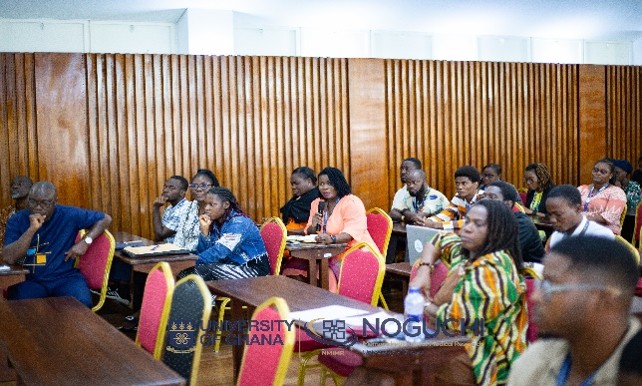
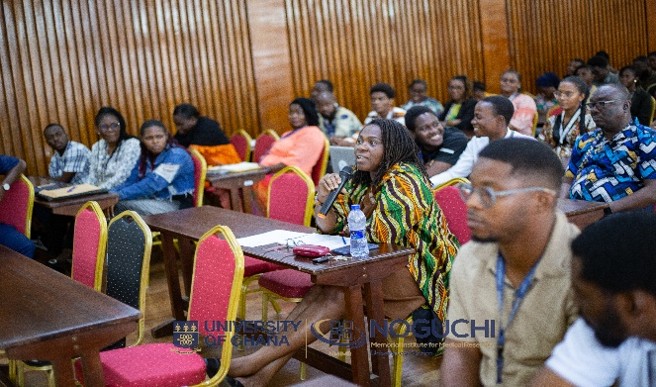


Participants engage in discussions during the question-and-answer session following the seminar on novel approaches toward HIV cure research.
The seminar underscored the importance of sustained investment in HIV research and highlighted the role of scientific innovation in addressing one of the most complex challenges in global health. It also reflected NMIMR’s commitment to conducting impactful research and contributing to improved health outcomes in Ghana and beyond.