

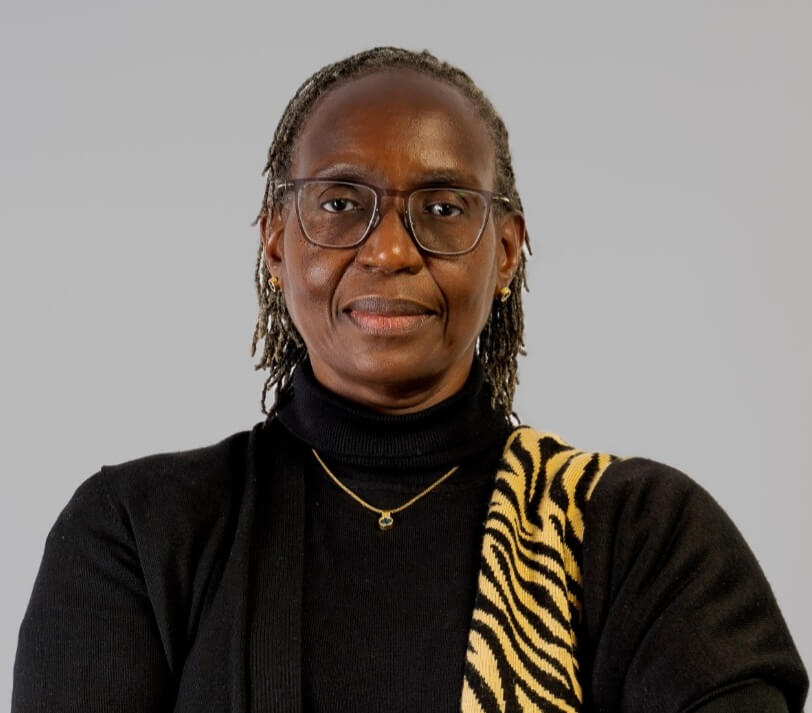
Prof. Elizabeth Bukusi, MBChB, M.Med (ObGyn), MPH, PhD, PGD (Research Ethics), MBE is a Fellow of the African Academy of Sciences (FAAS). She is a Senior Principal Clinical Research Scientist at the Kenya Medical Research Institute (KEMRI), a Research Professor at the University of Washington (Departments of Obstetrics and Gynecology and Global health), and an honorary lecturer at Aga Khan University in Nairobi and Maseno University (Department of Obstetrics and Gynecology). She also serves as Volunteer Clinical faculty – Professor at the University of California San Francisco (Department of Obstetrics, Gynecology & Reproductive Sciences) and Visiting faculty at the Centre for Biomedical Ethics and Culture (CBEC) at the Sindh Institute of Urology and Transplantation (SIUT). She is an honorary lecturer for the Master of Science in One Health and Emergency Research Ethics (MOHERE) program at the Department of Public Health Pharmacology and Toxicology at the University of Nairobi
Prof.Bukusi, in collaboration with Dr. Craig Cohen at UCSF, established the KEMRI Research Care and Training Program (RCTP) in 1995. She was the first lead faculty for the Bioethics program at Amref International University (AMIU) from its inception until August 2025, and she continues to serve as a faculty member in the program. She also serves at Mt Kenya University in the bioethics program as faculty. In addition to substantial experience in conducting socio-behavioral and biomedical research and providing HIV care, mentoring and training health care and research personnel to enhance local and international capacity, she has a strong interest in research and clinical ethics and the development of systems and structures for regulation of research. She was the founding chairperson of the National Bioethics Society of Kenya (BSK), was a board member of AVAC (up to 2024), and chaired the WHO HRP Alliance (capacity building for RH research) 2016 to 2021, and is a trustee for the HIV Trust. She is the Director of LEA -WH – a fellowship program working to transform the health of women in Africa by training the next generation of scientists and innovators on women’s health.

Kwadwo Asamoah Kusi is an Associate Professor in the Department of Immunology, Noguchi Memorial Institute for Medical Research (NMIMR), a constituent of the College of Health Sciences, University of Ghana, Legon. He started his career as a research scientist at NMIMR in 2012 after graduating with a PhD in Medicine (Vaccine Immunology) from Leiden University Medical Centre, the Netherlands, based on research that he conducted at the Biomedical Primate Research Centre in Rijswijk, the Netherlands. His research focuses on understanding immune responses to pathogens that cause diseases including malaria, Viral Hepatitis, COVID-19 and Lassa Fever. He works with collaborators at the US Naval Medical Research Center in Maryland, USA, to identify immune epitopes as vaccine candidate components for these diseases, focusing especially on how to overcome the effect of pathogen antigen diversity on immune response specificity. He is lead Immunologist for clinical trials that have been conducted at NMIMR over the last few years and worked on the first phase 1 Lassa fever clinical trial conducted in Africa between 2020 and 2022 (https://pubmed.ncbi.nlm.nih.gov/41208990/). This was a plasmid DNA based vaccine delivered with electroporation and sponsored by Inovio Pharmaceuticals, with funding support from CEPI. He is also currently working on the first Lassa fever vaccine to enter phase 2 trials, which is the vesicular stomatitis virus-delivered rVSV∆G-LASV-GPC vaccine from IAVI, also with funding support from CEPI. This is a multi-country trial being conducted in Nigeria, Ghana and Liberia, and his lab at NMIMR is conducting all immunological analysis including various types of ELISA, T cell ELISPOT assays and pseudovirus neutralization assays for the three trial sites. He is a member of the Vaccine Research and Development Committee of the Ghana National Vaccine Institute (NVI) and a member of the Viral Hepatitis Technical Working Group under the National Viral Hepatitis Control Programme. He serves as a part-time teaching faculty at the Department of Biochemistry, Cell and Molecular Biology and the West Africa Centre for Cell Biology of Infectious Pathogens (WACCBIP), University of Ghana. He currently has over 110 peer-reviewed publications and serves on the editorial boards of at least four international peer-reviewed journals.

Irene Akua Agyepong is a Public Health Physician and Foundation fellow of the Faculty of Public Health, Division of Physicians of the Ghana College of Physicians and Surgeons. She has an MBChB (1986) (University of Ghana Medical School); Masters Community Health (1991) (University of Liverpool School of Tropical Medicine); and Doctor Public Health (2000) (University of North Carolina at Chapel Hill). She has played leadership roles at the national and global level including Regional Director of Health, Greater Accra region of Ghana (2004 to 2012), first chair of the Board of Health Systems Global (2012 – 2014) and Professor Prince Claus Chair in Development and Equity, University Medical Centre, Utrecht, The Netherlands (2008 – 2010). She has been member and Chair of the Scientific and Technical Advisory Committee (STAC) of the WHO Alliance for Health Policy and Systems Research (2008 – 2013) and member of its Board. She received the Arnold Kaluzny distinguished alumni award of the Public Health Leadership program of the University of North Carolina at Chapel Hill in 2008. She has extensive research and publications related to Public Health / Health Policy and Systems.

Professor Linda Eva Amoah obtained her PhD in Chemistry from Georgetown University, Washington, DC, in 2007. She then spent two years at the Malaria Research and Reference Reagent Resource Center (MR4) in Manassas, USA, before joining the Noguchi Memorial Institute for Medical Research (NMIMR) as a Research Fellow in 2009. She is currently Professor of Immunology and Head of the Department of Animal Models and Preclinical Sciences at NMIMR.
Over the past 18 years, Professor Amoah’s research has focused on malaria transmission, with the overarching goal of malaria elimination. Her work centers on diagnostics, asymptomatic infections, and gametocyte biology, as well as the development of transmission-blocking immunity. Her laboratory takes an integrated approach, evaluating malaria transmission in the field while designing new transmission-blocking agents.
A major focus of her work is the development and evaluation of diagnostic tools capable of identifying all Plasmodium species in both symptomatic and asymptomatic infections. Beyond producing and evaluating transmission-blocking malaria vaccine candidates, her group investigates the development of transmission-blocking immunity and gametocyte production during natural infection. Her laboratory is also interested in identifying host genetic traits that enhance gametocyte conversion rates and influence the infectiousness of circulating mature gametocytes to the mosquito vector.
Professor Amoah is additionally a member of a consortium funded to implement Ghana’s first-ever malaria transmission-blocking vaccine trial.

Prof. JH Kofi Bonney
Education & Key Qualifications
- Ph.D. in Microbiology – University of Ghana
- M.Sc. in Medical Microbiology – University of East London, UK
- Research fellowship/training at the Bernhard Nocht Institute for Tropical Medicine in Hamburg, Germany (a WHO Collaborating Centre for Arboviruses and Viral Haemorrhagic Fevers).
- Post-Doctoral Fellowship at the University of Cambridge, School of Verterinary Medicine, under the Cambridge Africa Partnership for Research Excellence (CAPREx).
Current Roles & Leadership
- Associate Professor and Head, Department of Virology, NMIMR, University of Ghana.
- Chair, Safety Committees, NMIMR.
- Member, National Technical Coordinating Council (NTCC) on Pandemic and Emerging Infectious Diseases.
- Member, ECOWAS Regional Rapid Response Team (ERRRT) on Pandemic and Emerging Infectious Diseases.
Research Focus & Contributions
- Specialization: Molecular and serological surveillance of emerging and re-emerging infectious pathogens, including arboviruses (Dengue, Chikungunya, Zika) and Viral Haemorrhagic Fevers (VHFs) such as Ebola and Lassa fever. My research tracks how pathogens such as Ebola, Marburg, Lassa, Mpox, and various Arboviruses adapt to human hosts and move across different ecological landscapes.
- Key Achievements: Played a pivotal role in establishing diagnostic testing protocols for VHFs in Ghana, leading to the identification and documentation of Ghana’s first confirmed cases of Lassa fever.
- Active Projects: Genomic surveillance, molecular epidemiology of zoonotic spillover risks (e.g., bat- and mosquito-borne viruses), and health security strategies in West Africa.
Strengthening Laboratory Systems and Biosafety
- Committed to the development of robust diagnostic frameworks and biosafety standards. IFBA Professionally Certified, which validates expertise in managing biological risks within complex research environments. Interests in enhancing diagnostic capabilities for high-consequence pathogens in resource-limited settings. Advancing Biosafety Level 3 (BSL-3) operational protocols and institutional biosafety and biosecurity. Integrating a One Health lens into training needs assessments for laboratory personnel and researchers.
Published Research Work in Refereed Journals : 81
Bibliography in PubMed: https://www.ncbi.nlm.nih.gov/myncbi/kofi.bonney.1/bibliography/public/

Professor Evelyn Korkor Ansah is a Professor of Clinical Epidemiology at the Institute of Health Research, University of Health and Allied Sciences in Ghana. She is a Public Health Physician, an Epidemiologist, a fellow of the Ghana College of Physicians and Surgeons, a Rockefeller Foundation Bellagio Fellow and a Fellow of the Ghana Academy of Arts and Sciences.
She qualified in medicine at School of Medical Sciences, KNUST, holds an MPH from the University of Ghana and a PhD in Clinical Epidemiology from the London School of Hygiene & Tropical Medicine. Professor Ansah worked at all levels of Ghana’s health system in both Clinical and Public health roles for over 25 years prior to joining academia. With over 25 years of experience in Ghana’s health system Professor Ansah has worked as a clinician at Korle Bu and Ridge hospitals, as a District Director of Health Services, and as Deputy Director for Research in the Ghana Health Service.
Professor Ansah has served and continues serve at global and national levels. She is currently a member of the Malaria Policy Advisory Group (MPAG) of the World Health Organization (WHO). She has served on various global technical committees of the World Health Organization and the Global Fund to fight AIDS, Tuberculosis and Malaria including as Vice Chair of the Global Fund Technical Review Panel and member of the Independent Evaluation Panel (IEP) of the Global Fund to fight AIDS, Tuberculosis and Malaria. She was Scientific Co-chair of the 2024 MIM Pan African Malaria Conference and is the UHAS Lead and Faculty of the Science of Defeating Malaria Leadership course organized annually in collaboration with Harvard University and 4 other African Institutions.
Professor Ansah’s research interests include malaria, health systems, maternal health, implementation research, non-communicable diseases and capacity building for health research.
.

Laud Anthony Basing is a scientist, biomedical engineer, innovator, entrepreneur, and lecturer at the Department of Medical Diagnostics, Kwame Nkrumah University of Science and Technology, Ghana. He is Founder and CEO of Incas Diagnostics, a Ghanaian biotechnology company developing and manufacturing diagnostic technologies for human and agricultural health. His work spans clinical microbiology, biomedical engineering, public health, molecular diagnostics, point-of-care testing, and local diagnostic manufacturing. He has collaborated with institutions including the University of Liverpool, Purdue University, KNUST, and the World Health Organization on projects addressing climate-sensitive diseases, yaws eradication, sexually transmitted infections, and emerging infectious diseases.
Laud Anthony Basing has developed 27 diagnostic and biotechnology products, with seven additional products currently in the development pipeline. Of these, he has commercialized 13 human-health diagnostics, three agricultural diagnostic products, and three molecular point-of-care technologies. His innovation portfolio also includes several patented technologies.
His work also contributes to efforts to strengthen Africa’s diagnostic manufacturing capacity and improve access to affordable testing. His innovations have received recognition from WHO and other international organizations. He was named among WHO Africa’s Top 30 Health Innovators in 2019, led a five-country team that won the WHO COVID-19 Hackathon in 2020, and was recognized as a Gates Goalkeeper. In 2023, he received the Best Health Startup Founder Award at the Africa Health Excon in Cairo. Laud Anthony Basing is also the first Ghanaian to be nominated for the Innovation Prize for Africa. His other recognitions include first place in the Burton Morgan Business Model Competition and second place in the Schurz Innovation Challenge.
He regularly contributes to international discussions on diagnostic innovation, manufacturing, regulation, health systems, and Africa’s diagnostic self-sufficiency.