

Prof. Irene Ayi is a Ghanaian parasitologist whose research focuses on parasitic diseases of public health importance, including schistosomiasis, soil-transmitted helminth infections, and other neglected tropical diseases. At the Noguchi Memorial Institute for Medical Research (NMIMR), she has dedicated her career to improving the understanding, diagnosis, and control of parasitic infections that continue to affect communities across Ghana and Africa.
Through her research, mentorship, and collaborations, Prof. Ayi has contributed to strengthening disease control efforts, advancing parasite detection, and building scientific capacity for the next generation of researchers. Her journey from an unexpected beginning in parasitology to becoming a leader in infectious disease research reflects resilience, curiosity, and a lifelong commitment to improving public health outcomes.

Prof. Irene Ayi, Professor of Parasitology and Senior Research Fellow, Noguchi Memorial Institute for Medical Research (NMIMR), University of Ghana.
Meet Prof. Irene Ayi, a leading Ghanaian parasitologist whose story reflects a lifelong commitment to advancing research, mentorship, and the control of schistosomiasis and other neglected tropical diseases across Ghana and Africa.
Priscilla Kissi: What inspired you to study science and pursue a career in parasitology and public health research?
Prof. Ayi: Thank you for having me. My journey at the Noguchi Memorial Institute for Medical Research began through National Service after completing my undergraduate studies at the University of Science and Technology (UST, now KNUST) in 1991. I was initially assigned to the Virology Department, but towards the end of my service the late Professor Francis Nkrumah, who was then Director of Noguchi, encouraged me to join the Parasitology Department because of an upcoming research project. That decision marked the beginning of my career in parasitology. I became involved in a schistosomiasis research project led by Professor Kojima from the University of Tokyo, which provided me with the opportunity to train in Japan in monoclonal antibody technology and development of diagnostic tools for schistosomiasis. In 1999, I received the opportunity to pursue my PhD training in Japan, where I focused on toxoplasmosis and non-invasive diagnosis. My interest in this area was shaped by both my scientific curiosity and personal experiences, particularly the impact of parasitic infections on maternal and child health. These experiences motivated me to pursue research that contributes to better diagnosis, disease prevention, and improved healthcare outcomes.
Priscilla Kissi: How would you describe your research focus in simple terms?
Prof. Ayi: My research has not been limited to one area. I started with schistosomiasis and later expanded my work to other neglected tropical diseases, including soil-transmitted helminth infections and then malaria, which mainly affect children and women. I also developed an interest in diarrheal diseases, particularly infections caused by organisms such as Entamoeba, Giardia, and Cryptosporidium, because many diarrheal treatments focus mainly on bacterial and viral causes. Overall, my research focuses on parasitic diseases, with a strong interest in improving diagnosis. Accurate and early diagnosis is the first step towards effective treatment and disease control. Through my work, I have contributed to understanding these infections and improving approaches to their detection.
Priscilla Kissi: Over the years, you have contributed to parasitology and infectious disease research in different ways. What would you say are some of your most important contributions to parasitology and infectious disease research in Ghana and Africa?
Prof. Ayi: One of my major contributions has been through my work on schistosomiasis and other neglected tropical diseases. After my PhD, I joined a JICA-sponsored project on parasitic diseases involving 10 African countries, including Ghana. The project focused on epidemiology, strengthening laboratory capacity, and training technicians to identify parasites and their life cycle stages from urine and stool samples. Through the West Africa Centre for International Parasite Control (WACIPAC) project, we also supported advocacy, training, and awareness programmes across Africa. I facilitated workshops involving policymakers, health and education officials, and researchers, and helped train teams in countries including Benin and Sierra Leone. Some of these efforts contributed to strengthening national deworming programmes. I also contributed to school health initiatives in Ghana by helping train education officers and supporting the implementation of the country’s first national deworming programme in 2007. Beyond this, I have had the opportunity to contribute to WHO guidelines on controlling snail hosts responsible for schistosomiasis transmission. Currently, I am currently part of a multi-country project on female genital schistosomiasis, which aims to improve understanding, diagnosis, and management of this often-overlooked complication of schistosomiasis. Overall, my work has focused on using research, training, and collaboration to improve disease control and strengthen public health interventions in Ghana and beyond.

Some moments from Prof. Ayi’s fieldwork, showcasing her work in schistosomiasis research, community engagement and disease control.
Priscilla Kissi: Every research journey comes with challenges. What have been some of the major challenges you have faced in your work, and how can they be overcome?
Prof. Ayi: One of the biggest challenges has been securing research funding. Science is constantly evolving, so researchers must be innovative, identify research gaps, build strong collaborations and actively pursue competitive grants. Networking with other scientists and working across institutions has been key to overcoming this challenge. Another lesson I learned is the importance of understanding the requirements for career progression and ensuring that your work is properly recognised. Earlier in my career, I contributed to several research projects without always securing authorship or acknowledgement. Fortunately, the research environment has improved over the years with greater recognition of individual contributions. My advice to young researchers is to remain resilient, keep learning, collaborate widely, and never stop seeking opportunities to grow.

Prof. Ayi with some collaborators advancing research through partnership and shared expertise.
Priscilla Kissi: Beyond your research work, you are also involved in training young scientists. Why is mentorship so important in scientific research?
Prof. Ayi: Mentorship is essential because it helps young scientists discover and develop their potential. Just as a parent guides a child, experienced researchers guide the next generation by sharing knowledge, building their confidence, and helping them develop critical thinking and research skills. Looking back, I consider the late Professor Francis Nkrumah one of my earliest mentors because he saw potential in me and guided me into parasitology. Research also depends heavily on collaboration, networking, and securing competitive grants. Good mentors help young scientists navigate these challenges and connect them with opportunities that can shape their careers. Over the years, I have mentored many students from the University of Ghana, KNUST, UCC, UDS, Accra Technical University, and other institutions. It has been rewarding to see many of them become lecturers, researchers, and professors. Mentorship is a two-way learning process, and I have learned just as much from my students as they have learned from me. Some have even become like family, which is one of the most fulfilling aspects of my career.

Prof. Ayi on GTV Breakfast Show, discussing schistosomiasis and science mentorship.
Priscilla Kissi: Among your many contributions, which achievement in your career stands out the most to you, and why?
Prof. Ayi: One achievement that stands out is seeing my research in toxoplasmosis make a real impact on healthcare. The findings contributed to improving the diagnosis of toxoplasmosis in women at the reference laboratory at Korle Bu Teaching Hospital, making the diagnostic process more accurate and reliable. I am also proud of the students I have mentored over the years. One of my former master’s students at the University of Cape Coast went on to upgrade his work to a PhD, graduated as valedictorian and is now a professor and dean. Seeing my mentees succeed is one of the most rewarding aspects of my career. Another achievement has been my contribution to schistosomiasis control through advocacy, teacher training, community education, and my involvement in developing the World Health Organization (WHO) guidelines on controlling the snail hosts that transmit the disease. Knowing that this work continues to improve public health makes it especially meaningful to me.
Priscilla Kissi: What advice would you give to young scientists interested in parasitology and public health research?
Prof. Ayi: My advice is to keep learning and think beyond a single discipline. Research has evolved from working in isolated fields to embracing multidisciplinary approaches, so young scientists should develop a broad understanding of diseases, diagnostics, and emerging technologies. Parasitology remains highly relevant. Many parasitic infections are still under-researched, and their interactions with other diseases can influence diagnosis, treatment, and health outcomes. As researchers, we must look at diseases holistically rather than in isolation. Most importantly, be curious, read widely, identify research gaps, and never stop asking questions. Every study, no matter how small, should contribute to improving public health and healthcare delivery especially in Africa.
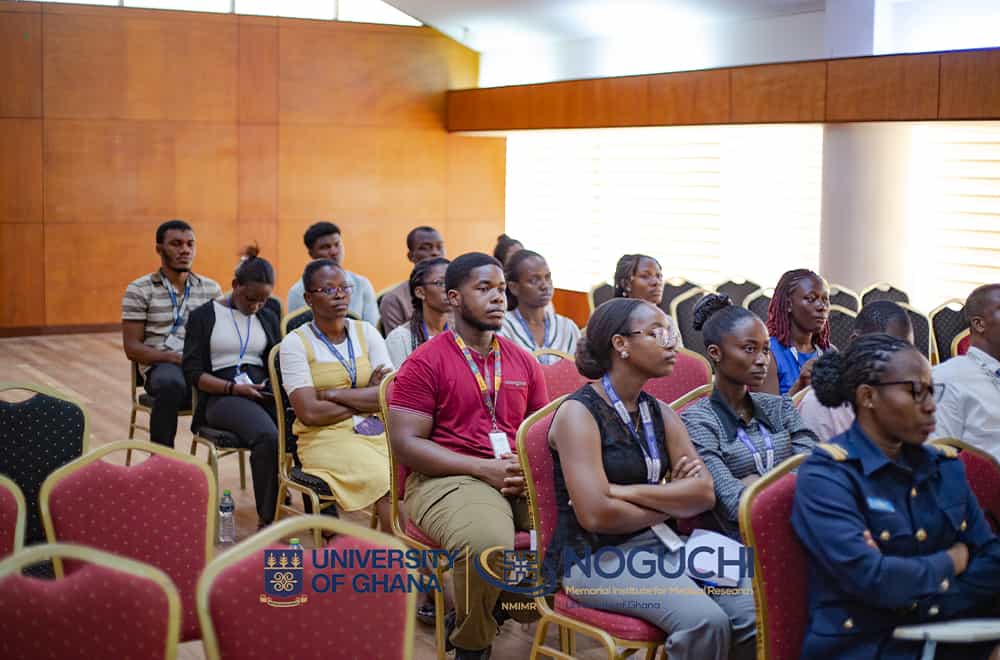
A cross-section of young scientists at the AiDx Multi-Diagnostic training, learning to advance public health research.
Priscilla Kissi: As a final reflection, what lasting impact do you hope your work in parasitology and public health research will have?
Prof. Ayi: I hope my work contributes to changing how we diagnose and manage infectious diseases, particularly by encouraging healthcare professionals to look beyond malaria when patients present with fever. Many infections can mimic malaria, and improving differential diagnosis will lead to more accurate treatment and better patient outcomes. I also hope my research encourages greater collaboration across scientific disciplines. Today, parasitologists, virologists, bacteriologists, and other specialists increasingly work together, and I believe this integrated approach is the future of public health research. Ultimately, I hope my work contributes to stronger healthcare systems, inspires the next generation of researchers, and improves the health and well-being of communities in Ghana, Africa, and beyond.
Priscilla Kissi: Thank you Prof. Ayi, for sharing your work on schistosomiasis and improving the diagnosis and control of parasitic diseases. Your dedication continues to strengthen public health and inspire future researchers in Ghana, Africa, and beyond.
Prof. Ayi: Thank you. It has been a pleasure sharing my perspective.