
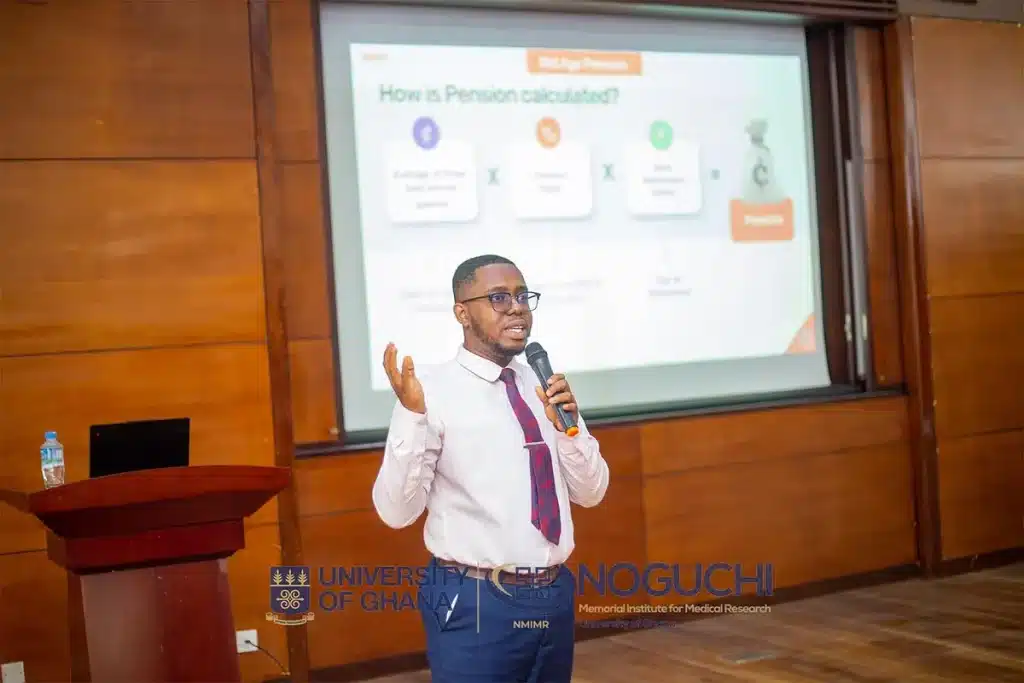
The Noguchi Memorial Institute for Medical Research (NMIMR), University of Ghana, has held an institutional seminar to educate staff on the Social Security and National Insurance Trust (SSNIT) scheme, its benefits and the importance of planning for retirement.
The seminar, held on Tuesday, 13 October 2026, at the Institute’s Conference Room, featured a presentation by Mr Kwasi Gyan, a member of the Public Education Team at SSNIT, on the topic, “The SSNIT Scheme: Providing Hope for All Workers.”
During his presentation, Mr Gyan explained Ghana’s three-tier pension scheme, outlining the roles of SSNIT, privately managed occupational pension schemes and voluntary pension arrangements. He explained that contributions are shared between employers and employees, with a total contribution of 18.5 per cent of an employee’s basic salary. Of this amount, 5 per cent is allocated to the second-tier occupational pension scheme, while 13.5 per cent is remitted to SSNIT. He further explained that 2.5 per cent of the amount remitted to SSNIT is transferred to the National Health Insurance Scheme (NHIS), leaving 11 per cent for the administration of the first-tier pension scheme.
Mr Gyan highlighted the four principal benefits provided under the SSNIT scheme: old-age pension, invalidity pension, survivors’ lump sum and emigration lump sum. He explained that members generally require a minimum of 180 months, equivalent to 15 years of contributions to qualify for a monthly old-age pension at age 60. He also outlined the factors used in calculating pension benefits, including declared earnings, the number of months of contributions and the age at retirement. Participants were informed that early retirement, between the ages of 55 and 59 years and 11 months, attracts a reduced pension, subject to the applicable requirements.

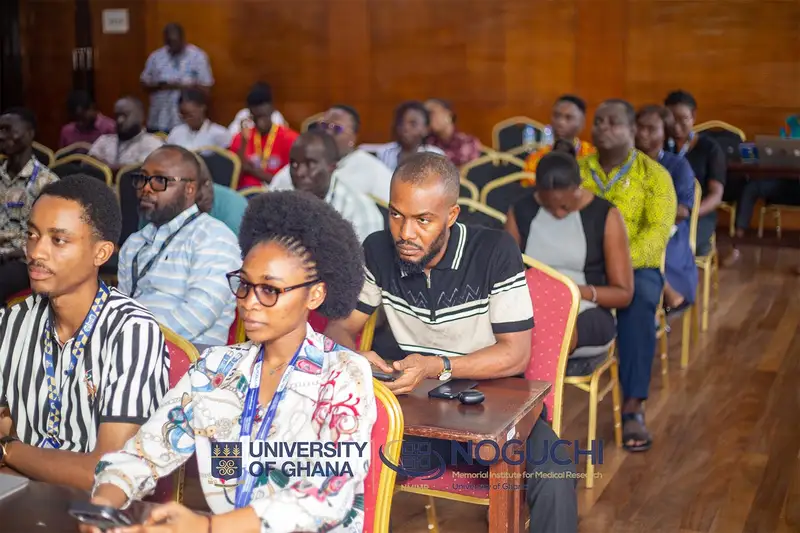
Participants listening attentively during the presentation on the SSNIT scheme and retirement planning.
Emphasising the importance of adequate retirement planning, Mr Gyan urged staff to ensure that their basic salaries are accurately declared for pension contributions. He explained that SSNIT pension benefits are calculated based on declared basic salaries rather than total earnings. He therefore encouraged employees to engage their employers on their salary structures and ensure that the appropriate contributions are remitted, noting that the level of declared earnings has a direct bearing on the pension benefits received at retirement.
He also stressed the importance of regularly checking pension contribution statements and updating nominated dependants. Members were encouraged to review their beneficiary records whenever their personal circumstances changed to help ensure that benefits are paid to the appropriate dependants. He further introduced participants to SSNIT’s digital services, including its mobile application and virtual branch, which enable members to access selected services remotely.
The presentation also highlighted additional services available to members and pensioners, including the SSNIT Membership Value Programme, which offers discounts at participating businesses, and the telehealth service for SSNIT pensioners.
An interactive question-and-answer session followed the presentation, during which staff sought clarification on various aspects of the scheme. The questions covered the distribution of pension contributions, differences between SSNIT and other pension arrangements, eligibility for retirement benefits, contributions by individuals who operate additional businesses, and access to benefits after retirement. Mr Gyan addressed the questions and provided further explanations to help participants better understand their pension entitlements.
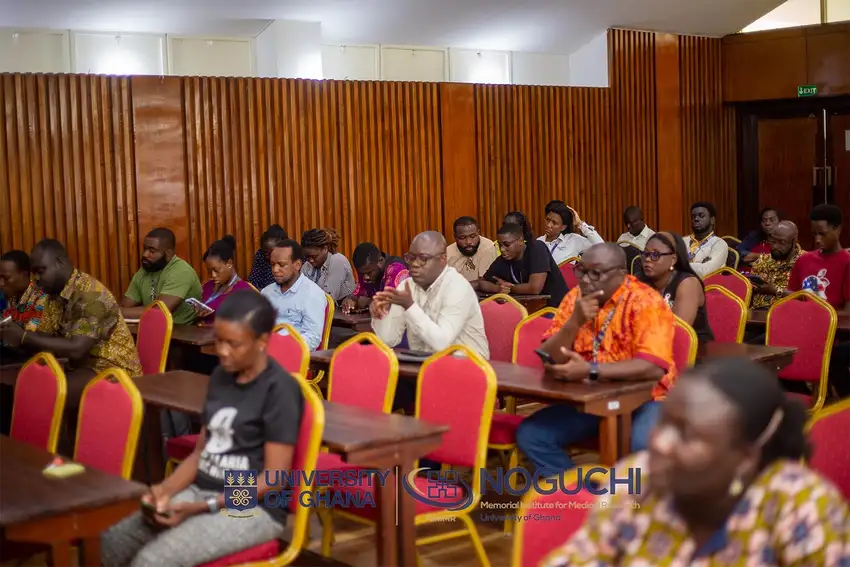
A participant engaging Mr Kwasi Gyan during the question-and-answer session at the NMIMR institutional seminar on the SSNIT scheme.
The seminar reinforced the importance of pension awareness and proactive retirement planning. It encouraged staff to monitor their contributions, maintain accurate beneficiary records and make informed decisions to support their financial wellbeing beyond active service.